
Appearance
✨ v-model 的本质 👌
要点速览
- v-model 在编译后会展开为:
prop: modelValue+event: update:modelValue(在模板中以onUpdate:modelValue体现)。 - 两大使用场景:① 表单元素与响应式数据双向绑定;② 父子组件之间的数据同步(子改父)。
- defineModel 是编译期宏,等价于子组件接收
modelValue与触发update:modelValue,并在本地保持一个同步的 ref。
使用场景
- 表单元素双向绑定
- 子组件对父组件数据的双向通信(含具名 v-model)。
场景一:表单元素与响应式数据双向绑定
html
<template>
  <div>
    <p>输入的内容为:{{ message }}</p>
    <input type="text" v-model="message" placeholder="请输入内容" />
  </div>
</template>

<script setup>
  import { ref } from "vue";
  const message = ref("Hello");
</script>

<style>
  input {
    padding: 8px;
    margin-top: 10px;
    border: 1px solid #ccc;
    border-radius: 4px;
  }
</style>
编译结果与说明

- v-model 被展开为一个名为
onUpdate:modelValue的自定义事件,事件处理函数为:
jsx
($event) => ($setup.message = $event);- 输入值改变会触发该事件,从而写入响应式数据;而输入框的
value又与setup.message绑定,数据变化驱动重新渲染,界面同步更新。
表单常见注意点
- 输入法合成(IME)场景可能影响触发时机,可用
v-model.lazy或手动监听change控制行为。 - 数值/空白处理可用修饰符:
v-model.number、v-model.trim。 - 自定义组件充当输入框时,需要显式以
modelValue/update:modelValue对齐 v-model 的编译约定。
场景二:父子组件数据同步(子组件使用 defineModel)
App.vue
html
<template>
  <div class="app-container">
    <h1>请给产品打分:</h1>
    <RatingComponent v-model="rating" />
    <p v-if="rating > 0">您的评分:{{ rating }}/5</p>
  </div>
</template>

<script setup>
  import { ref } from "vue";
  import RatingComponent from "@/components/RatingComponent.vue";
  const rating = ref(3); // 评分的状态值
</script>
子组件 RatingComponent.vue
html
<template>
  <div class="rating-container">
    <span v-for="star in 5" :key="star" class="star" @click="setRating(star)">
      {{ model >= star ? '★' : '☆' }}
    </span>
  </div>
</template>

<script setup>
  // 接收父组件通过 v-model 传递过来的状态
  const model = defineModel();

  function setRating(newRating) {
    // 通过触发更新事件(defineModel 已处理为本地 ref 同步)
    model.value = newRating;
  }
</script>

<style scoped>
  .rating-container {
    display: flex;
    font-size: 24px;
    cursor: pointer;
  }
  .star {
    margin-right: 5px;
    color: gold;
  }
  .star:hover {
    color: orange;
  }
</style>
编译结果与说明
App.vue: 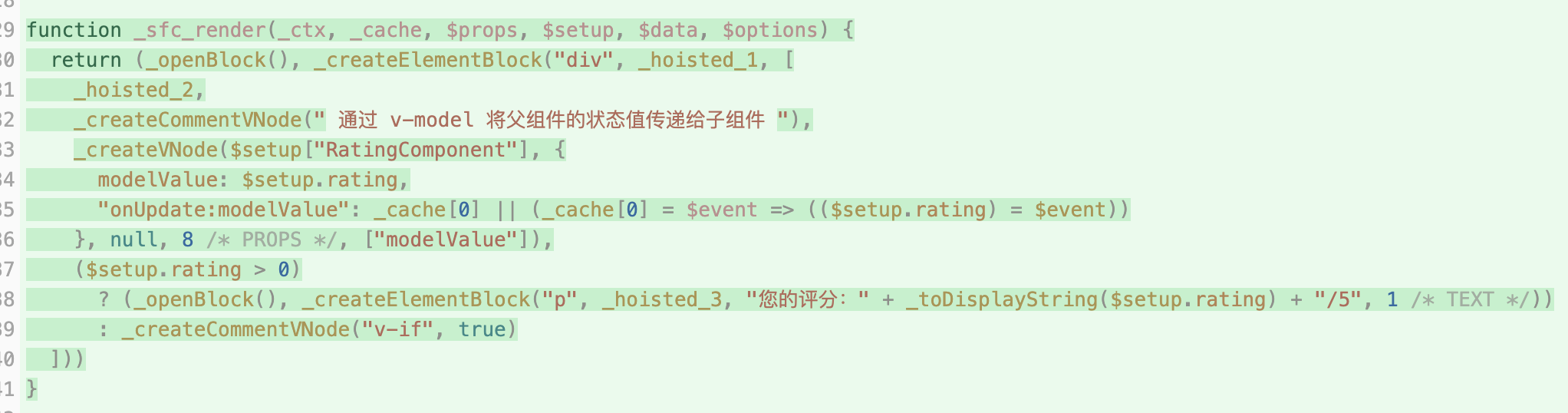
- 传给子组件一个
modelValue的 prop,值为$setup.rating;并传入onUpdate:modelValue事件,事件处理函数为:
jsx
($event) => ($setup.rating = $event);RatingComponent.vue: 
- 子组件通过
modelValue读取父值;更新时触发update:modelValue,父侧事件处理将新值写回到自身状态。
具名 v-model
具名 v-model 会改变 prop 与事件的命名:

- Props:
modelValue→title - 自定义事件:
update:modelValue→update:title
命名与约定
- 父模板里是
v-model:title;展开后对应:title与onUpdate:title。 - 子组件需以
title作为 prop,并触发update:title事件,或使用defineModel('title')统一处理。
小结
总结
- v-model 的核心是“prop + 事件”的约定:
modelValue与update:modelValue(模板中onUpdate:modelValue)。 - 表单场景:事件驱动数据写入,数据变化再驱动界面更新;可用修饰符控制行为。
- 组件场景:子通过事件告诉父更新;
defineModel简化了子侧实现与同步逻辑。